Deal structures
Four structures are being offered to operators right now. Each transfers a different package of value to a different party.
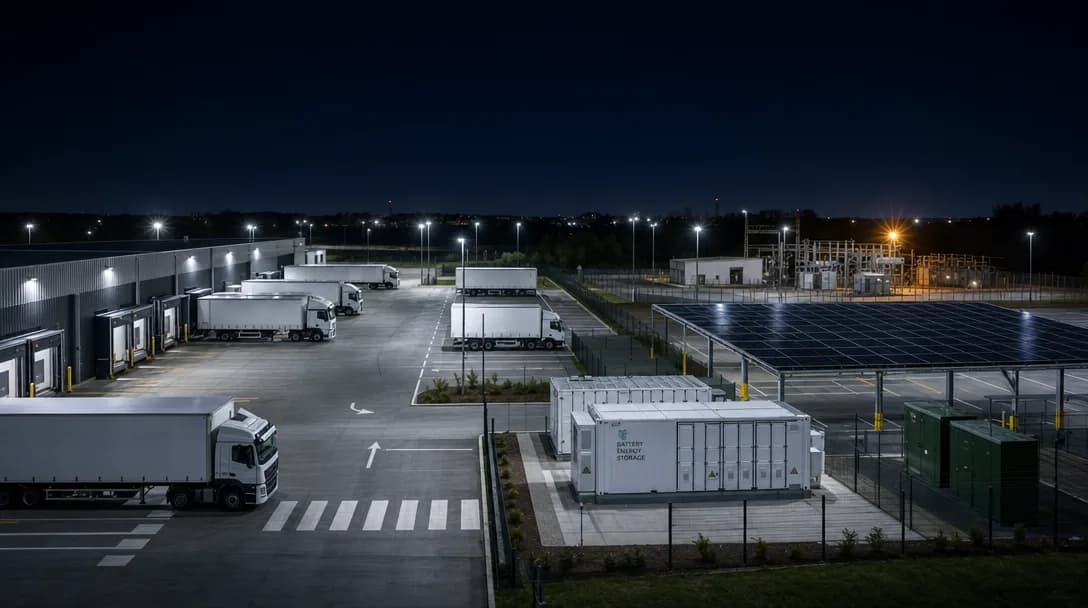
Four structures are being offered to operators right now. This page works through each, names the UK proponents, and sets out the questions to ask before signing any of them.
The four decisions inside every deal
Every depot energy infrastructure deal makes four decisions: who owns the physical asset, who manages the energy, who keeps the grid services revenue, and who carries the residual asset value at end of contract. Reading the deal in front of you is reading those four decisions. In the structures that follow, watch which ones the operator keeps.
Asset wrap
The financier owns the battery, chargers, sometimes the on-vehicle batteries and solar array. The operator pays a pence-per-mile rate or fixed monthly fee. The financier covers the capex, manages the assets, and retains the grid services revenue and residual value throughout the contract term — typically ten to fifteen years.
Zenobé is the dominant UK example. KKR equity over £600m, £410m of bus financing closed in 2024, 122+ depots and 3,400+ EVs globally. The Revolv acquisition in North America is the HGV expansion vehicle. The bus playbook is being carried forward into UK haulage.
The structure solves capex, skills, and connection timeline in one move. It transfers everything else. Asset, energy management, grid services revenue, residual value — all on the financier's side of the table for the full contract term.
The disclosure gap is real. Zenobé's per-depot economics are opaque from outside. Bus2Grid ran for three years at Northumberland Park and never published a per-bus revenue figure. Operators considering an asset wrap have no public benchmark.
Ask before signing: What is the contract length? What is the residual value treatment and the operator's buyout option at end of term? What £/MW/year benchmark and depot capture factor are assumed? What are the exit terms? Has the financier published comparable site-specific economics — and if not, why not?
Energy-as-a-service
The operator owns the physical assets. A third party runs the optimisation — charging algorithm, energy procurement, flex bidding — on a revenue share basis. Three sub-types matter.
Pure optimisation: the third party handles smart charging, day-ahead procurement, and flex bidding. Octopus Kraken and Flexitricity's FlexGo (launched autumn 2025) are the cleanest UK examples. Revenue share 70/30 to 80/20 in the operator's favour on flex services.
Full energy management: optimisation plus operational oversight, sometimes with component financing. VEV is the dominant example, deploying at Stagecoach Nuneaton and across Maritime Transport's thirteen depots. Revenue share less standardised, varies by project.
Grid trading only: operator owns and runs everything, contracts a flex aggregator solely for grid services bidding. GridBeyond, Drax, Habitat Energy, Statkraft, Centrica and Enel X compete here. Revenue share typically 80/20 to 85/15 in the operator's favour.
The structural advantage over asset wrap: the operator keeps the asset, the residual value, and the majority of the energy revenue. The trade-off: the operator carries the capex, warranty, regulatory risk, and any performance shortfall.
Revenue definition is where the contractual fighting happens. A 70/30 split on a generous gross definition is materially different from the same split net of imbalance costs, warranty deductions, charger downtime, and aggregator fees. The difference can be a third of the headline number. Get a worked example for a recent operational month.
Ask before signing: Which sub-type? What is the exact revenue definition? Show me a worked example for one operational month. Who owns the optimisation IP and data? What is the performance benchmark and the remedy for underperformance?
Connection wrap
An Independent DNO owns the connection asset — substation, transformer, cable from the public network. The IDNO recovers its capital through a long-term capacity charge on the operator's supply, typically over 30 to 40 years. The operator runs everything inside the meter and pays for the connection as opex rather than capex.
Aurora Utilities (I Squared Capital) is the most active UK example, having connected Stagecoach depots including Bow, Cheltenham, Dover, Inverness, Stockton and Walkergate. Energy Assets (KKR) and GTC offer comparable arrangements.
The structure solves the connection timeline — IDNOs can sometimes deliver faster than the regulated DNO because their capital structure rewards delivery. Everything inside the meter stays with the operator: asset ownership, energy management, grid services revenue, residual value.
The disclosure gap is the long-term capacity charge. Over thirty years an IDNO arrangement is not always cheaper than a DNO connection. The comparison rarely gets done properly at deal stage. Do the NPV calculation for the full term, not the headline connection cost.
Ask before signing: What is the NPV of the total capacity charge over the full contract term, and how does it compare to the DNO alternative on the same basis? What are the assignment and exit terms if the site or business is sold? Who owns the connection asset at end of term?
Asset Wrap
The financier owns the battery, the chargers, and sometimes the on-vehicle batteries. The operator pays a pence-per-mile rate or a fixed monthly fee.
Zenobé (KKR equity, £600m+); Voltempo via partnership routes.
- Chargers and reliable power delivery
- Capex removed from the operator balance sheet
- Operations support during the contract
- Asset ownership and residual value
- All grid services revenue
- Flex trading, DSO flex, Capacity Market
- Optionality on contract extension
| Deal | Owns the asset | Captures flex revenue | Captures network value | Contract term | Operator exit rights |
|---|---|---|---|---|---|
| Asset wrap | Financier | Financier | Financier | 10–15 yrs | Buy-out clause; rarely favourable |
| EaaS | Operator | Shared (typ. 50–70% operator) | Operator | 5–10 yrs | Notice period; data retention varies |
| Connection wrap | IDNO (financier) | Operator | Operator | 30+ yrs | Limited; capacity charge persists |
| Full-stack ownership | Operator | Operator | Operator | Per-service contracts | Full control |
Full-stack ownership
The operator owns and runs everything — asset, energy management, flex bidding, aggregator relationships. Maximum upside, maximum complexity, maximum exposure to capital and regulatory risk.
No UK haulier has done this at scale and published the economics. Maritime Transport gets closest: over 22 MW of installed charging across thirteen depots and terminals during 2026, backed by ZEHID grant funding, with Maritime ZERO offering third-party charging access. Maritime hasn't disclosed flex market participation. The closest comparable structure in bus — Stagecoach — uses VEV for the energy management overlay, making it EaaS-with-asset-ownership rather than full-stack.
This is the right structure for operators with the balance sheet and the appetite to build the capability. The evidence base for what "well" looks like is thin. ZEHID grant funding makes it tractable for participating operators — which is exactly why the disclosure obligation that should come with public money is the first policy ask at /report/policy.
Ask before starting: What is the in-house energy management capability today? What is the realistic plan to build or contract what is missing? What are the regulatory exposures and how are they managed?
At a glance
| Deal type | Asset ownership | Grid services revenue | Residual value | Operator capex | UK example |
|---|---|---|---|---|---|
| Asset wrap | Financier | Financier | Financier | None (opex) | Zenobé |
| Energy-as-a-service | Operator | Shared (70/30–80/20) | Operator | Full | VEV, Flexitricity, Octopus Kraken |
| Connection wrap | IDNO (connection) / Operator (inside meter) | Operator | Operator | Reduced | Aurora Utilities, Energy Assets |
| Full-stack ownership | Operator | Operator | Operator | Full | Maritime Transport (closest) |
The cells in the operator's column are what they keep. The cells in the financier's column are what they capture in exchange for capital and risk transfer. An asset wrap with an operator buyout option at year ten is meaningfully different from one without. Read the contract, not the headline.
Questions to ask in any conversation
Independent of structure, these are the questions worth having answered in writing.
Who has signed this deal type in the UK — and can I speak to one of them?
What is your assumed flex revenue, expressed as £/MW/year?
What is your assumed depot capture factor?
What is the contractual definition of revenue for any revenue share calculation?
What is the residual asset value treatment at end of contract?
What are the exit and termination terms?
What happens if the assets underperform?
What is the network cost avoidance assumption in the modelling?
What is the evidence base for the revenue assumptions?
What regulatory changes over the contract term would materially affect the modelled returns, and how are those risks allocated?
If the answer to any of these is silence, that is the answer. There is no good reason any of it should be confidential between counterparties about to enter a multi-year contract.
Contractual fine print
Five points that rarely get enough attention from operator-side legal teams.
Revenue share calculation. Define revenue gross, then enumerate every deduction — imbalance costs, aggregator fees, warranty hits, downtime adjustments, settlement fees. Each should be capped or subject to operator review.
Residual asset value. Many wrap contracts default to financier retention with no operator buyback option. This is a substantial unstated value transfer at year ten or fifteen. Specify upfront.
Exit and termination. What happens if the operator sells the depot or the business. What happens if the financier is acquired. What happens if regulatory changes make the underlying economics materially different. Each scenario needs a contractual answer.
Performance benchmarks. Charger uptime, battery capacity retention, software availability, flex participation rates. Who measures, who arbitrates, what is the remedy.
Step-in rights. The triggers, the operator's cure periods, the conditions for restoration of control. These matter and rarely get tested in template contracts.