The value stack
Five revenue lines, what each is worth, and where the evidence base is thin.
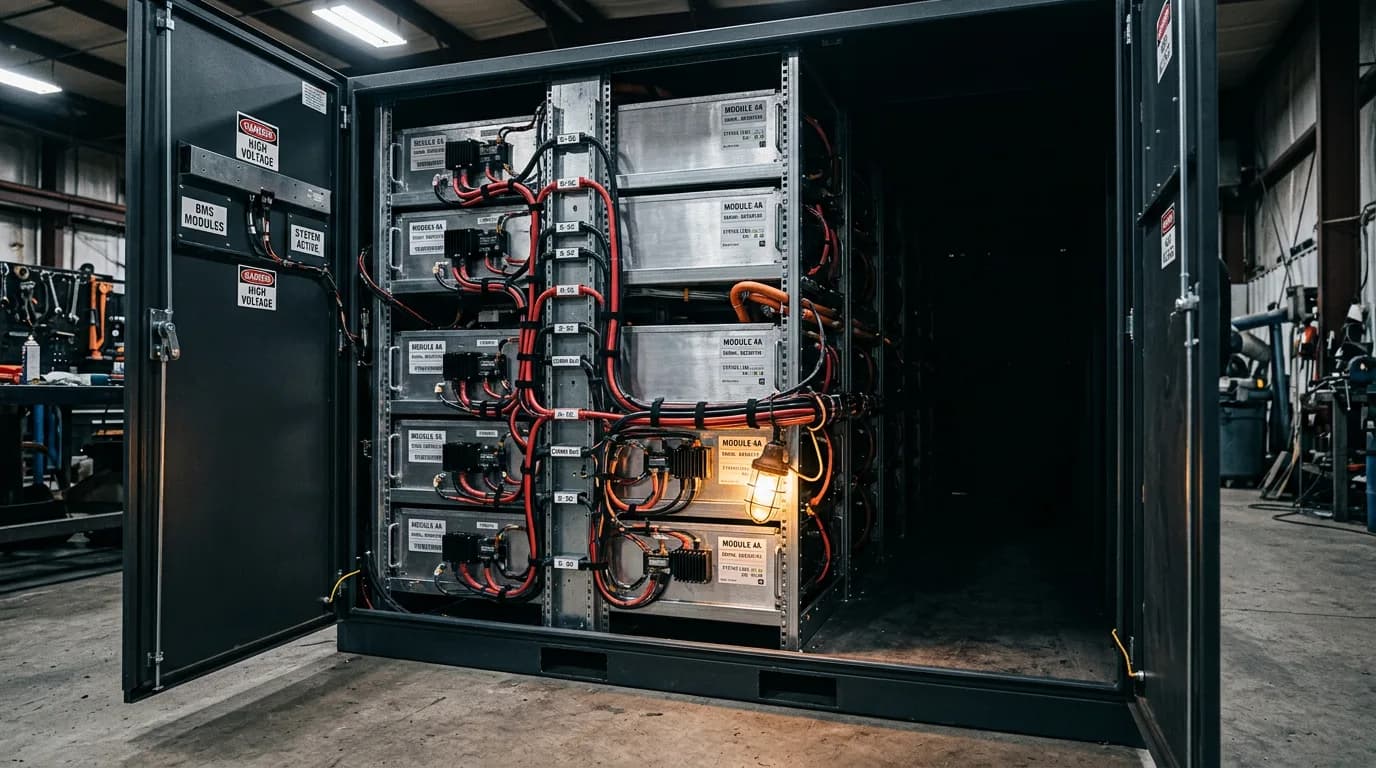
This page sources every number on the depot energy value stack, names every assumption, and lays out what the published evidence base does and does not support. The spine names the five lines; this page shows the working.
Methodology
The reference depot is a UK logistics site in 2026: 30 trucks, 6,000 sqm of roof, 11 kV or 33 kV connection. Three principles apply throughout.
Revenue is modelled as realistic operator capture, not theoretical merchant maximum. Where the literature reports merchant figures, a capture factor is applied and the range stated.
Capex uses commercial 2026 UK pricing, not grant-funded or trial-deployment figures.
Where the evidence base is thin, the model says so. Absence of evidence is a finding, not a gap to fill.
Solar self-consumption
Every kWh of on-site generation consumed on site saves roughly 25p against commercial supply tariffs. At 900 kWp on 6,000 sqm of south-of-England roof, generating 880 MWh per year at 70% self-consumption, the bill saving is around £155,000 per year.
Self-consumption ratio is the variable that matters most. Cold stores and mixed-use sites with continuous daytime load hit 75–85%. Sites with concentrated nighttime charging and little daytime baseload hit 40–60%. Battery storage shifts either figure up by around 15 percentage points.
Solar exported at 6p per kWh against a 25p import is a four-to-one value gap. Size for maximum self-consumption, not maximum generation.
Network cost avoidance
This is the line the aggregator's pitch deck doesn't show, because the aggregator can't bill for it.
Every UK commercial electricity bill carries three network components: energy charges, DUoS (time-of-day banded), and TNUoS (fixed-band against Available Supply Capacity). Together they make up between a quarter and a third of the total bill.
TNUoS fixed-band charges rose 64% in April 2026. Every kW of ASC the battery allows you to drop saves that charge at the new rate — lasting and structural. DUoS red-band exposure compounds it: the 4pm to 7pm window carries charges 8 to 12 times the off-peak rate, directly into the HGV return-to-base cycle.
Realistic value per kW of ASC reduction: £50 to £200 per year, midpoint £100. On a 1 MW battery with 700 kW of effective ASC reduction, the annual network avoidance line is around £70,000 — typically two to three times the flex trading line on the same site.
Flex trading
The reference number is the Modo Energy GB BESS Index: £70,000 per MW per year average through 2025, range £47,000 to £88,000. January 2026 trailing figure: £52,000. This is the merchant benchmark — and it is not what a depot battery earns.
Three factors compress the realised figure. The trading desk competes directly with the charging schedule. Smaller aggregators serving smaller assets carry higher per-MWh participation costs. Sites outside DSO constrained zones earn nothing from local flex.
Realistic depot capture: 15% to 60% of merchant benchmark, giving £15,000 to £45,000 per MW per year. A passive operator with a capacity-management contract sits toward the bottom. An operator willing to push the trading desk's authority over charging schedules, located in a constrained zone, sits toward the top.
V2G and Capacity Market
V2G. The technology works. The commercial revenue doesn't yet match the modelling. Project Sciurus projected £725 per vehicle per year, delivered ~£360. e4Future projected £700 to £1,250 per vehicle, never published audited outturn. No UK haulier has disclosed transacted V2G revenue. Conservative underwriting range: £400 to £800 per vehicle per year. Build the case on analogous realised numbers, not on car or bus trial projections.
Capacity Market. The 2026/27 T-1 cleared at £5 per kW per year — down 75% from £20 the year before. Every depot business case that assumed £15 to £25 per kW before March 2026 is stale. For a 1 MW battery, the realistic CM line is around £3,500 per year. Real money; not enough to close a marginal case.
The 20p floor argument
The strongest challenge to the depot energy hub thesis came from an energy supplier in Workshop 1: there is no foreseeable future in which the structural cost of electricity in northern Europe falls below 20p per kWh. Network charges, environmental levies, capacity payments, and wholesale price together form a floor.
The implication runs the other way. A structural price floor means the bill savings line is structural too. The 64% TNUoS rise isn't transient. Every electron behind the meter is worth more, not less, if the floor holds. The supplier was right about the floor. The reading is the operator case.
The academic evidence base
Five papers do the structural work supporting the depot case.
Seward, Qadrdan and Jenkins (2022) modelled a UK behind-the-meter battery stacking day-ahead wholesale with frequency response. Stacking improves investment viability and — counter-intuitively — reduces battery degradation, since frequency response availability payments incentivise a narrow state-of-charge band rather than hard arbitrage.
Martins and Miles (2021) covers the broadest UK service set in the literature: Capacity Market, frequency response, STOR, BM arbitrage with co-located solar and wind. Payback estimates predate Dynamic Containment maturation and the 2026 CM collapse — treat as a lower bound, not a current benchmark.
Mohamed et al. (2022) found revenue stacking boosts annual income 129% against single-service operation, average payback eight years, for distribution-connected BESS in Northern Ireland.
Nunez Munoz et al. (2023) is the only peer-reviewed UK depot model in the pool. PV+BESS delivers meaningful cost reduction when a grid upgrade is available; without one, smart charging is essential. This is exactly the UK operator situation.
Brinkel et al. (2023) modelled six charging strategies at Dutch bus depots. Peak shaving alone cuts charging costs 23–32%. Day-ahead market participation adds another 6–11%. Near-elimination of net charging costs is achievable with aFRR participation — but at the cost of severe local grid peaks.
The academic gap: no paper yet models all six UK flexibility services together for a single commercial HGV depot with realistic grid connection costs. The full source list is at /report/methods.
The practitioner evidence base
Modo Energy's GB BESS Index is the reference merchant benchmark. Cornwall Insight provides the most active forward-looking flexibility market analysis — pre-March 2026 CM forecasts are stale. Aurora publishes longer-horizon storage outlooks aimed at investor audiences; apply depot capture factors separately. NESO's DFS publishes accepted-volume and clearing-price data; from April 2026 it opens to bidirectional flex at 0.1 MW threshold. ENA Open Networks reports DNO flex contracting: 9 GW contracted, 22 GWh dispatched, £300m bill-payer savings in 2024, with UKPN paying up to £600 per MWh at maximum utilisation.
None of these publishes operator-side outturns for HGV depots specifically. That data doesn't exist in public form. Closing this gap is the first policy ask at /report/policy.
The capex stack
Solar PV at depot scale: £700 to £900 per kWp installed. Battery storage: £300 to £400 per kWh (Allye MAX300 gives ~£350 per kWh as a named reference). HGV-scale DC charging: £20,000 to £35,000 per dispensed kW. Grid connection: £20,000 to £80,000 for a small upgrade within existing capacity; £500,000 to £2m for HV reinforcement; £15m for a 33 kV substation at logistics park scale (East Midlands Gateway, Workshop 1 evidence).
Full capex stack for the reference 30-truck depot — solar, battery, ten charging bays, new connection: £2.5m to £4m. ZEHID and BEFH cover a meaningful proportion for participating operators.
Close
The value stack is real. The realistic numbers are smaller than the trade press headlines and larger than the conservative defaults operators sometimes use. The biggest line is network cost avoidance, not flex trading. The Capacity Market line collapsed in March 2026. V2G should be priced conservatively until UK HGV operators publish outturns.
Who keeps this value is the deal question. That's /report/deals.