Are solid-state batteries coming to save your fleet?
Every few months a new solid-state battery announcement lands and I find myself wondering: is this actually real, or is it another press release?
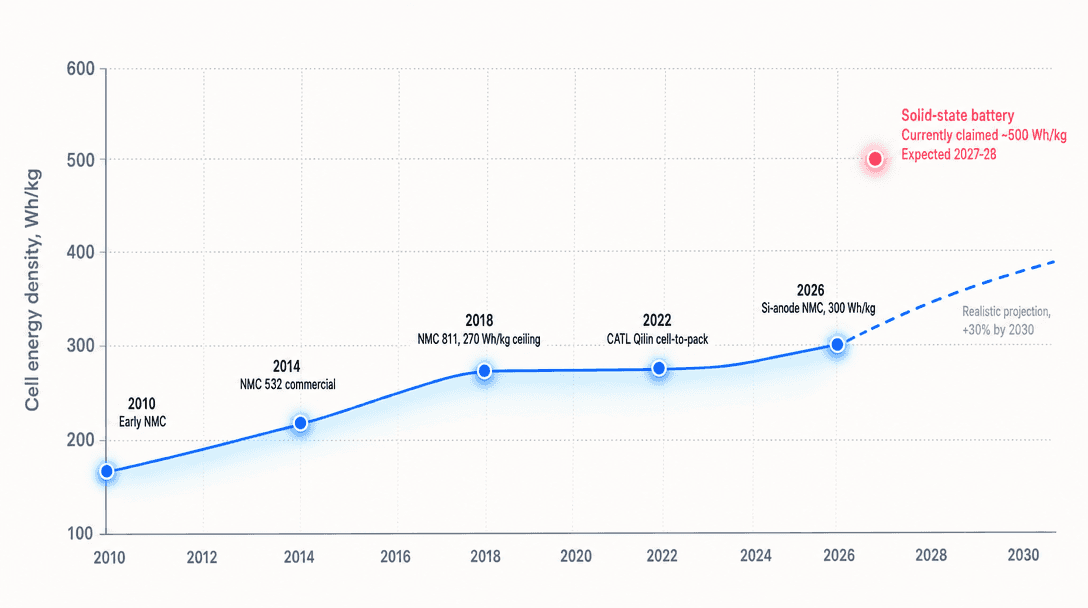
A Finnish startup called Donut Lab spent last year telling everyone they had a working solid-state battery. 400 Wh/kg. Five-minute charging. A hundred thousand cycles before any meaningful degradation. They went so far as to launch a counter-PR website called IDonutBelieve.com, with branded tinfoil hats for sale.
Last month, the CCO of their manufacturing partner filed a criminal complaint saying the headline specs had never actually been hit. The battery being demoed was an older unit from a different supplier that had since moved on to a v2 nobody had been told about. The manufacturing partner was, incidentally, a company Donut Lab had invested in.
I'm not here to play judge and jury. The Finnish courts will figure it out. But Donut Lab is one entry on a long list, and the list itself is the story.
What the engineering literature actually says
Across the independent technical literature on solid-state batteries, the picture is consistent in a way the press releases obscure.
In 2024, twenty-one research groups across Asia, Europe, and North America ran an exercise published in Nature Energy that should have been simple. Each group received identical commercial materials: NMC-622 cathode, Li6PS5Cl solid electrolyte, indium foil. Each used the same standardised electrochemical procedure. Initial discharge capacities came back ranging from 23.7 to 143.1 mAh/g, a six-fold spread. Capacity retention ranged from zero to over 100%. Forty-three percent of the attempted cells failed in assembly or cycling.
In well-resourced academic labs, with identical materials, almost half the cells failed.
The Technology Readiness Level data tells the same story. A 2023 cost-and-process analysis by Voss and colleagues placed sulfide-based cathodes via the wet processing route at TRL 6, the highest among observed solid-state production processes. Oxide-based and dry-process routes sat at TRL 4. Co-sintering, required for oxide chemistries, was identified as 'far from industrial scale' and the principal barrier to manufacturing scale-up.
TRL 6 is pre-commercial. TRL 4 is laboratory validation. Neither is mass production.
The energy density story is similarly compressed when you read past the marketing. A 2022 paper in Chemical Engineering Journal Advances by Yim and colleagues looked directly at the 100% improvement figure quoted in most solid-state announcements. Their conclusion: 30% is 'a more reasonable target for the near future.' To approach the theoretical 2x gains, the electrolyte layer has to thin to below 20 micrometres at scale, which nobody has demonstrated. The catholyte fraction has to drop, which fights against rate capability. The anode has to approach lithium-metal or anode-free, which is exactly where the dendrite and yield problems live.
The cost numbers, from the same Voss study, are blunt. At giga-scale, current solid-state cathode production runs roughly three times the cost of an equivalent lithium-ion cathode. The optimistic future scenario, which assumes the manufacturing problems get solved, narrows that to a 16% premium for oxide cathodes, with sulfide dry-process routes possibly reaching cost parity at the cathode level. Both contingent on unresolved problems.
The safety story is being oversold too. A 2024 UCL group examined what actually happens when a solid-state cell fails. Internal short circuits can discharge up to 70% of total cell energy in under sixty seconds, with substantial self-heating. The solid electrolyte does not reliably prevent lithium filament propagation. It is safer than liquid-electrolyte lithium-ion, in the way a smaller fire is safer than a larger fire. It is not inherently safe.
The HGV-shaped hole in the literature
Here is the bit that should make every fleet operator pay attention.
When you search the independent technical and economic literature for studies that evaluate solid-state batteries specifically for heavy goods vehicle deployment, you find nothing. The HGV decarbonisation literature, including major UK-focused studies, treats current lithium-ion chemistry as the only relevant option. Solid-state isn't dismissed. It just isn't there.
That is not a sampling error. The people writing the technical and economic literature on how the UK gets its trucks to zero emissions don't consider solid-state a near-term option worth modelling.
For context, a battery-electric HGV today using conventional lithium-ion already carries a TCO premium of 11 to 33% over diesel. Wang et al. calculated that closing that gap requires a further 56% reduction in current battery costs. Solid-state, even on the optimistic future curve from Voss, sits above current lithium-ion costs, not below. The maths doesn't work for HGV procurement until well into the 2030s, on the most generous assumptions.
The pack-size problem compounds this. Long-haul HGVs need 300 to 600 kWh packs versus 60 to 100 kWh for passenger cars. Every yield problem, every interface failure mode, every cost penalty scales with that pack size. Ceramic solid electrolytes are mechanically brittle. The temperature ranges and vibration loads a truck sees in service are not what those chemistries have been validated against.
The silver bullet that isn't coming
Solid-state is not the silver bullet for freight decarbonisation. Nothing is. That is the point worth sitting with, because it applies to everything else on the runway too.
The history of this transition will be made up of small, unglamorous improvements. Better thermal management on existing cells. A 5% improvement in pack-level energy density from a new module design. A grid connection that finally arrives. A telematics platform that reduces deadhead miles by a percent. A driver training programme that improves regen recovery. A 200kW depot charger that turns out to actually deliver 180kW reliably. A route-planning algorithm that gives back 4% of the daily energy budget. Each one of these is a small bullet. Add fifty of them together over a decade and you have a transition.
The seduction of a single breakthrough is real. It is much easier to write a press release about doubling energy density than about a tighter route-planning algorithm. It is much easier to fund a startup with a 400 Wh/kg pitch than a fleet that wants a substation upgrade. So the press releases come, the funding rounds close, the procurement decisions get pushed back six more months. We'll wait for solid-state. We'll wait for solid-state v2. We'll wait for sodium-ion to mature. We'll wait for hydrogen to make economic sense.
While we wait, we run diesel.
Every procurement cycle skipped is two to three years of trucks that could have been electric, running diesel instead, putting carbon up the stack that the operator is meant to be removing. The cost of waiting is not zero. It is exactly the cost of every mile burnt on diesel because the fleet refresh got deferred in the hope that what's coming will be meaningfully better than what's here.
The procurement frame that works
Decide on a refresh cycle. Five years, six years, whatever the fleet economics support. In that cycle, buy the best thing that exists and runs the route. When the cycle comes round again, buy the best thing that exists then.
If you defer one cycle, you have lost the carbon of every mile in that cycle. You haven't reduced uncertainty about what comes next, because the next thing was always going to be both better and a little disappointing relative to the press release. You've just bought yourself another five years of waiting.
Read the announcements. Note them. File them next to the previous ones. Then carry on.
Buying trucks that exist. With batteries that work. For routes that need running.
That part I do know.
Want to see how solid-state and lithium-ion actually compare on the numbers that matter for commercial EVs? Interactive comparison here.