The Hydrogen Debate in Transport: A Reality Check
Once touted as a rival to battery-electric, hydrogen's role in road transport is now under scrutiny. Here's where it actually stands.
Hydrogen. There, I said it. Talk about an elephant in the room, this one's a mammoth. It's just a simple element, the simplest in fact, but it's got a lot of baggage in road transport. Just last year at the Motor Transport Decarbonisation Summit, hydrogen was being hailed by some as the saviour, a serious contender against battery electric. It was BEV vs H2, a "horses for courses" debate. But this year? Hydrogen's role felt almost like a punchline; just saying the word brought sniggers across the room. The conversation has shifted to hydrogen for niche, maybe ultra-specialised applications, if at all.
A history of unfulfilled promises
This isn't hydrogen's first rodeo. In the early 2000s, we saw similar enthusiasm when GM launched its HydroGen series and Honda introduced its FCX hydrogen fuel cell vehicles, which later evolved into the FCX Clarity in 2008. Back then, hydrogen was also touted as the future of transport. Two decades later, those early promises remain largely unfulfilled, while battery electric vehicles have gone from niche to mainstream.
Don't get me wrong, I've got nothing against hydrogen per se. It's a fantastic molecule, especially in its green form. In the right places, hydrogen does real work: think steelmaking, where it cuts carbon emissions like nothing else. Or ammonia production. Ever tried feeding the world without fertilisers? It's got serious credentials.
The efficiency challenge
Hydrogen fuel cells had a promising start. But for transport? Let's be real: hydrogen fuel cells come with a hefty price tag, not to mention the complexity of building out a fuelling network to match the scale of what batteries already offer. Hydrogen also loses efficiency at nearly every step, from production to compression to storage and finally conversion into energy in a vehicle. Those energy losses are staggering compared with what we get from a battery-electric setup.
Let's put some numbers to those losses. A typical well-to-wheel efficiency for hydrogen fuel cell vehicles hovers around 30%, while battery electric vehicles achieve about 70-80%. That's not a small difference; it means hydrogen vehicles require more than twice the energy input for the same distance travelled. When we're talking about fleet operations and bottom lines, these efficiency gaps translate directly into operating costs.
Safety and infrastructure concerns
Now, hydrogen combustion? In theory, it's got some appeal for transport; just burn the stuff for energy. But there's a catch: hydrogen still needs to be produced and transported at a cost that makes sense, and that's no small challenge. Getting it from production sites to where it's needed economically remains a significant hurdle, and then there's that word, burn, I'm sure someone said we need to stop doing that.
There's also the safety factor. Hydrogen is highly flammable, and while there are systems in place to manage it, there's no escaping the risks when transporting or storing it in large quantities. Battery-electric systems, though not perfect, are generally considered less volatile, with advances in cooling and containment technology making them safer year on year.
The infrastructure gap
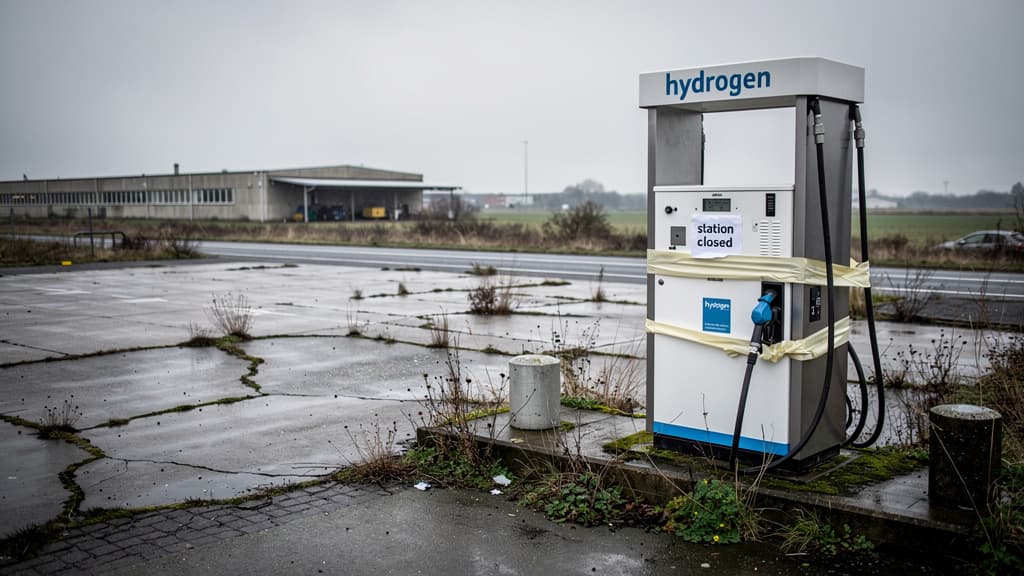
The infrastructure gap tells its own story. Globally, there are over 7 million public EV charging points, compared with just over 1,000 hydrogen fuelling stations. Even in California, which has invested heavily in hydrogen infrastructure, there are only about 60 retail hydrogen stations compared with tens of thousands of EV chargers, and that number keeps falling as operators pull out. This disparity isn't just about numbers; it's about the momentum of investment and the network effects that come with scale.
And it's not just about quantity. While EV charging infrastructure can be scaled incrementally, from home chargers to workplace installations to public networks, hydrogen requires significant upfront investment in specialised fuelling stations. Each hydrogen station costs millions to build and maintain, requiring specialised equipment and safety measures that make the economics challenging even before considering fuel costs.
Real-world performance and policy trends
Commercial fleet operators are seeing similar patterns. Many have found hydrogen infrastructure and fuel supply too sparse and expensive to make it practical. Large fleet operators report that hydrogen trials are too often limited by high overheads and limited infrastructure, making the technology a hard sell compared with the more straightforward rollout of battery-electric vehicles. Meanwhile, brands like Volvo and Tesla are doubling down on battery electric for heavy-duty applications, where they're seeing strong results in real-world scenarios.
Let's be honest: hydrogen trials for transport have been tried across all kinds of industries, from freight and aviation to rail and shipping, and results have been disappointing. Several well-publicised projects have scaled back or been scrapped altogether after hydrogen proved impractical and costly in real-world logistics. Major players have since shifted their focus towards battery-electric solutions, recognising hydrogen's limitations.
Government support and global trends
In Europe and the UK, policy still points one way. The UK's ZEV mandate sets binding, rising targets for zero-emission vehicle sales, and the EU's Alternative Fuels Infrastructure Regulation requires a charging network built out along the core road corridors. For transport companies making future-proof investments, the regulatory direction and the public infrastructure build-out both make battery-electric the clear choice.
The US is the exception, and it's instructive. The federal EV tax credits were repealed in 2025 and charging funding was pulled back, so Washington has stepped away from supporting battery-electric. But it hasn't stepped towards hydrogen either; the retreat is from clean transport generally, not a bet on fuel cells. China, the world's largest automotive market, has essentially abandoned hydrogen for passenger vehicles, focusing instead on expanding its already vast electric vehicle charging network. Even Japan, long the loudest proponent of the "hydrogen economy", has shifted much of its mainstream transport focus towards battery-electric vehicles.
Future possibilities
Could hydrogen still find a place in transport? The answer isn't a hard "no." Breakthroughs in hydrogen storage, production efficiency or even compact fuelling infrastructure could alter the equation. Researchers are exploring advanced electrolysis techniques that could potentially make hydrogen cheaper and more sustainable, while some companies are investigating hydrogen "paste" or solid-state hydrogen storage, which could address transport and safety concerns.
Then there's the possibility of a mixed-technology future. In specialised applications, like long-haul remote routes where battery charging infrastructure is limited, hydrogen could complement battery electric, providing a backup solution for edge cases where batteries fall short. In this scenario, hydrogen might be used sparingly, only where battery systems can't provide enough range or durability.
Battery technology itself is also advancing fast. Solid-state batteries, with greater energy density and faster charging times, are on the horizon and could fill many of the gaps hydrogen was initially seen as a solution for. The continued improvement in battery recycling and reuse also promises to make battery-electric technology more sustainable in the long term.
The economic reality
What's particularly telling is how the economics have evolved. While hydrogen fuel cell vehicles were once expected to become cost-competitive through scale, battery electric vehicles have instead achieved this milestone. Battery costs have plummeted by over 90% in the past decade, while hydrogen fuel cell systems remain expensive to produce and maintain. The learning curve for battery production has proven steeper and more rewarding than that for hydrogen systems.
The collapse of HVS underscores this economic challenge. Despite around £25m in UK government grants and roughly £55m raised in total, plus a credible order book, the company couldn't establish a sustainable business model. It went into administration and its assets and intellectual property were sold in a pre-pack deal for just £145,000. A company that raised tens of millions ending up as six-figure salvage value tells you most of what you need to know. It illustrates the wider challenge facing all the startup truck brands: bridging the gap between prototype development and commercially viable mass production.
This economic reality extends beyond vehicle costs. The simplicity of battery-electric systems (fewer moving parts, simpler maintenance requirements and more straightforward fuelling infrastructure) creates a compelling total cost of ownership advantage that's becoming harder to ignore. While hydrogen vehicles require complex systems of compressors, tanks and fuel cells, battery-electric vehicles basically need batteries, motors and controllers.
Conclusion
The bottom line is, for most road transport needs, battery-electric vehicles are already delivering, with efficiency, infrastructure and cost all tilting the scale in their favour. So, what's next? Are we ready to put our focus and our investments into the tech that's already solving the problem? Or are we still dreaming of a hydrogen highway that might just be a mirage?
Perhaps the most telling aspect isn't the technology itself, but rather the market's verdict. While hydrogen remains important for industrial applications, the transport sector has largely made its choice. As we face the urgent need to decarbonise transport, we can't afford to wait for hydrogen to overcome its fundamental challenges. The future of transport is increasingly electric, not because we chose it to be, but because that's where the technology, economics and practical realities have led us.