Why Driverless Freight Will Scale Faster Than the Robotaxi
Freight gets to pick the easy road, sell to a buyer who already does the maths, and carry a load that nobody worries about. Passenger AV has to do the opposite on all three.
Almost everything written about self-driving vehicles is about cars. The robotaxi gets the headlines, the nervous think-pieces and the city-by-city scorecard. Freight gets treated as the slow cousin that will get there eventually, once the clever stuff has been proven on passengers. I think that's backwards. Driverless freight will scale faster than driverless passenger transport, and the reasons have almost nothing to do with the technology and almost everything to do with how the two things actually operate.
Here's the claim in one line: freight gets to pick the easy road, sell to a buyer who already does the maths, and carry a load that nobody worries about. Passenger AV has to do the opposite on all three. That gap compounds.
The easy road is the whole game
The hardest part of autonomy isn't the driving, it's the unboundedness of the problem. A robotaxi has to cope with pedestrians stepping off kerbs, cyclists undertaking, school runs, double-parked deliveries, roadworks that moved overnight and someone leaving the pub at eleven. It has to handle all of it, everywhere it operates, because you can't sell a taxi that only works on Tuesdays on the ring road.
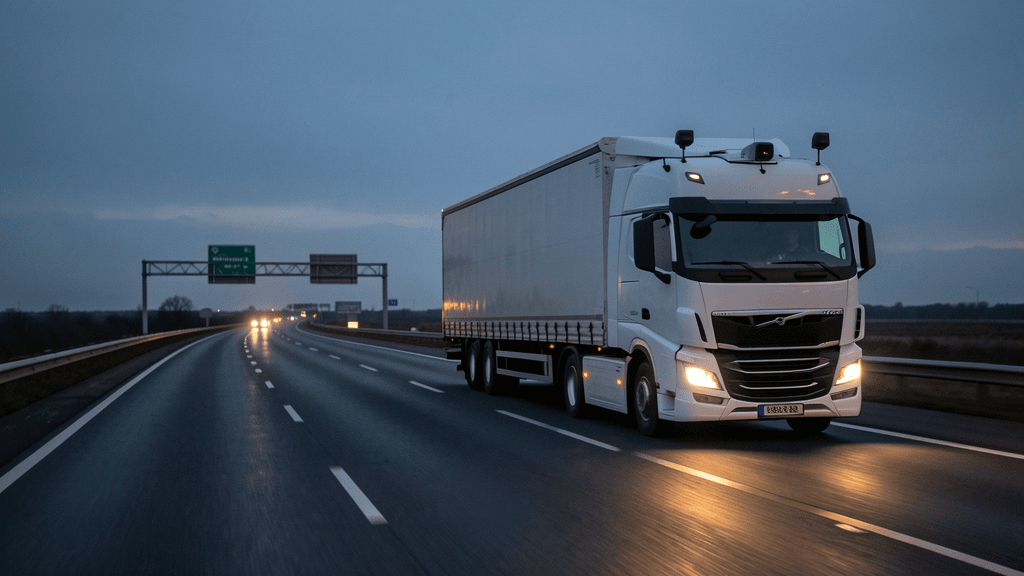
A motorway trunk run between two distribution centres is the opposite kind of problem. It's bounded, repeatable, and you get to define it tightly. The industry term is the operational design domain, the specific set of conditions a system is cleared to work in, and freight's ODD is a gift. Pick a corridor, prove it, run it a thousand times. The same applies to a short shuttle between a port and a nearby depot: low speed, fixed route, controlled at both ends. This is exactly what the eFREIGHT Autonomous study, run by Voltempo with Connected Places Catapult and Berkeley Coachworks and funded through CAM Pathfinder, identified as the UK's two clearest early use cases, hub-to-hub trunking and intermodal shuttles, precisely because the routes repeat and the interfaces can be controlled. Freight doesn't have to solve the general case. It gets to start with the easy 80% and leave the messy urban kerbside for later. Passenger transport has to eat the hard part first.
There's a buyer with a spreadsheet
Freight autonomy sells to operators who already think in cost-per-mile, utilisation and asset sweat. The value lands on day one and it's legible: a truck that can run twenty hours instead of being capped by a driver's hours is simply a better-utilised asset, and every transport manager can do that sum in their head. Goldman Sachs Research expects autonomous trucks to be cheaper per mile than human-driven ones by 2028, but the utilisation gain matters more than the wage line. You're not waiting for anyone to fall in love with the product. You're showing a rational buyer a better return.
Robotaxi has to win the opposite battle: consumer trust, one nervous passenger at a time, across a whole population, with the entire proposition resting on people choosing to get in. B2B adoption with a clear ROI has always outrun B2C behaviour change, in every technology cycle there's ever been. Autonomy won't be the exception.
The commercial model reinforces it. The likely shape for freight is autonomy bought as a service: you keep procuring or leasing vehicles the way you do now, an operations provider runs the no-user-in-charge layer (remote supervision, the safety case, the regulatory responsibility), and you bring functions in-house as confidence grows. That maps cleanly onto leasing and contracted operations that fleets already understand. The UK study sizes that service market at around £1.58bn a year by 2040 on the two priority use cases alone. Robotaxi, by contrast, needs whole new constructs of ownership, ride-hailing and pricing built from scratch. One model slots into existing behaviour. The other has to invent it.
Nobody's nervous on behalf of a curtainsider
An empty cab hauling pallets clears a far lower bar of public and political acceptance than a driverless car with your kids on the back seat. The anxiety that surrounds passenger AV, the viral clip of a robotaxi stopping in a junction, the instinctive unease about trusting your family to software, just doesn't attach to a box of car parts on the M6 at 3am. Freight carries the load that nobody is frightened for. That sounds like a soft point. It isn't. Social licence is one of the hardest things for passenger AV to manufacture and one of the things freight barely has to think about.
The bounded version is already two decades old
Here's the part that should end the argument. The case that heavy vehicles can drive themselves, at commercial scale, safely, for years, is not a forecast. It's history. Komatsu has been running commercial autonomous haulage since 2008 and commissioned its thousandth driverless ultra-class truck this April; its customers have moved more than 11.5 billion tonnes of material that way. Caterpillar's autonomous fleet has shifted more than 8.6 billion tonnes across over 325 million kilometres, with no reported injuries. These are the heaviest vehicles on earth, running around the clock, driverless, in commercial production, while the robotaxi was still doing demo laps.
The reason it worked there first is the same reason it'll scale on freight corridors next: a mine is a perfectly bounded ODD with a buyer who lives and dies by cost-per-tonne. Sound familiar? And the pattern is now visibly stepping off the mine site. Caterpillar has taken that proven autonomy into its first quarry, where the driverless trucks matched the productivity of crewed machines within months, moved over two million tonnes in the first year, and recorded no safety injuries. Quarrying is aggregates, and aggregates is one of the exact use cases the UK freight work identifies. The bounded, commercial, heavy-vehicle case isn't hypothetical. It's been paying for itself since before the first robotaxi carried a passenger.
Britain is already proving the public-road version
You don't even have to leave the public network to see freight's logic playing out ahead of passenger AV. The CAVForth project puts a full-size Stagecoach single-decker on a scheduled service across the Forth Road Bridge, negotiating motorways, roundabouts and live traffic, with twenty drivers retrained from Stagecoach's own team into new roles. A large vehicle, run as a commercial service by a professional operator on a fixed, repeatable route. It's a bus, but it's the trunking model in everything but the cargo, and it works for the same reasons: bounded route, professional operator, clear operational case. The firm behind it, Fusion Processing, builds collision-avoidance kit for buses and trucks alike, so even the hardware crosses over.
That's not a coincidence, it's a programme. CAM Pathfinder, the £150m effort delivered by the Centre for Connected and Autonomous Vehicles with Innovate UK and Zenzic, is funding driverless buses, HGVs, airport shuttles and autonomous yard tractors side by side, and the learning crosses over by design. One project is studying regional remote-operator control centres built to serve public transport, logistics and emergency response together, the same off-board model the freight business case depends on. The fixed-route, professional-operator, bounded-domain cases are scaling first, and freight sits squarely in that category. For those of us who've spent time inside CAM Pathfinder, that's the obvious read: the bus and quarry work is de-risking the freight case before a single driverless artic turns a wheel on a UK motorway.
The obvious objection
The fair rebuttal is that there are more robotaxis on the road today than robotrucks, and that's true. Waymo has driven over 127 million fully autonomous passenger miles and reports roughly a ten-fold drop in serious crashes against human drivers. Passenger AV has had more capital, more public miles and more years in the spotlight. And in the UK the regulation genuinely is passenger-first: the Automated Vehicles Act doesn't fully land until the second half of 2027, with passenger services first in the queue.
But "scales faster" is a claim about trajectory and ceiling, not about today's headcount. Freight starts from a smaller base and climbs a smoother hill, because its constraints are easier and its buyers more rational. The honest caveats still apply, and operators should hold them: the truck-specific safety data is thin and only now being mandated, with California's reporting rules taking effect in May 2026, and safer on average is not the same as safe in every moment, with edge cases like emergency vehicles still hard. There are system risks too, cheaper road freight could pull traffic off rail, and the cost and complexity of early adoption could favour the big operators and squeeze the SMEs who make up most of the sector. None of that is a reason to look away. It's a reason to be in the room.
Because that's the real point for anyone running trucks. The robotaxi will keep getting the headlines. Freight will quietly get the scale. And the operators who do well out of it won't be the ones who watched the passenger story unfold and assumed theirs would follow. They'll be the ones who understood their version was going to move faster, and were ready when it did.
Further reading
- eFREIGHT Autonomous, Early-stage CAV opportunities within UK heavy road freight (Connected Places Catapult / Voltempo / Berkeley Coachworks, April 2026)
- Zenzic CAM Pathfinder programme and project directory
- CAVForth (Fusion Processing, Stagecoach, Alexander Dennis, Transport Scotland)
- Komatsu FrontRunner and Caterpillar Cat MineStar / Command
- Aurora Innovation Q4 2025 shareholder letter
- MODI (Horizon Europe / CCAM) - the Rotterdam-to-Oslo automated freight corridor
- Axios, The math is improving for autonomous trucks (May 2026), drawing on Goldman Sachs Research
- Waymo Safety Impact data (through 2025)
- UK Government, Automated Vehicles Act 2024