Guides / Grant funding / Innovation
You're the scarce resource. Not the funding.
The truck and depot grants are money chasing operators. Innovation funding is the opposite: it's everyone else chasing you. The researchers, the OEMs, the energy companies, the tech firms. They all need something an operator has and they can't fake. A real fleet, a real route, real data.
Talk to us about a trialEvery demonstrator programme, every consortium bid, every trial has the same gap at the centre of it. An operator willing to run the thing for real.
There's no shortage of clever technology, and no shortage of public money to develop it. What there's a shortage of is depots that'll plug it in, drivers who'll run it on a live shift, and operators who'll share what actually happened.
That's leverage. Most operators never use it.
The instinct is understandable. You're running an operation on thin margins. A trial looks like a distraction, an open-ended commitment of time you don't have, for a payoff that lands on someone else's roadmap.
But that reading misses what you bring. A research consortium can model a duty cycle. It can't generate a real one. An OEM can spec a truck. It can't tell you how it behaves on your worst route in February. The operational reality is the bit nobody else can supply, and it's the bit the whole programme is built around.
Which means the terms sit more in your favour than you'd think. Funded vehicles. Funded infrastructure. First sight of kit years before it reaches the market. A seat where the standards and the policy get written. You don't pay to get in. You're the reason it runs.
The landscape, in one view
Different pots. Same machine. All of them need an operator.
These don't sit in separate boxes. They're one connected system, most of it part of the government's Industrial Strategy and routed through the same few bodies. Money flows from research and manufacturing at the top, down through autonomy and demonstration, to live freight trials at the sharp end, and out to the port edge where road freight meets the water. At every stage, the thing that turns a funded idea into a real result is an operator who'll run it.
Innovate UK
UKRI · the spine
National
agency
DRIVE35
DBT + Innovate UK + APC
£4bn
to 2035
CAM Pathfinder
CCAV + Zenzic + Innovate UK
£150m
to 2030
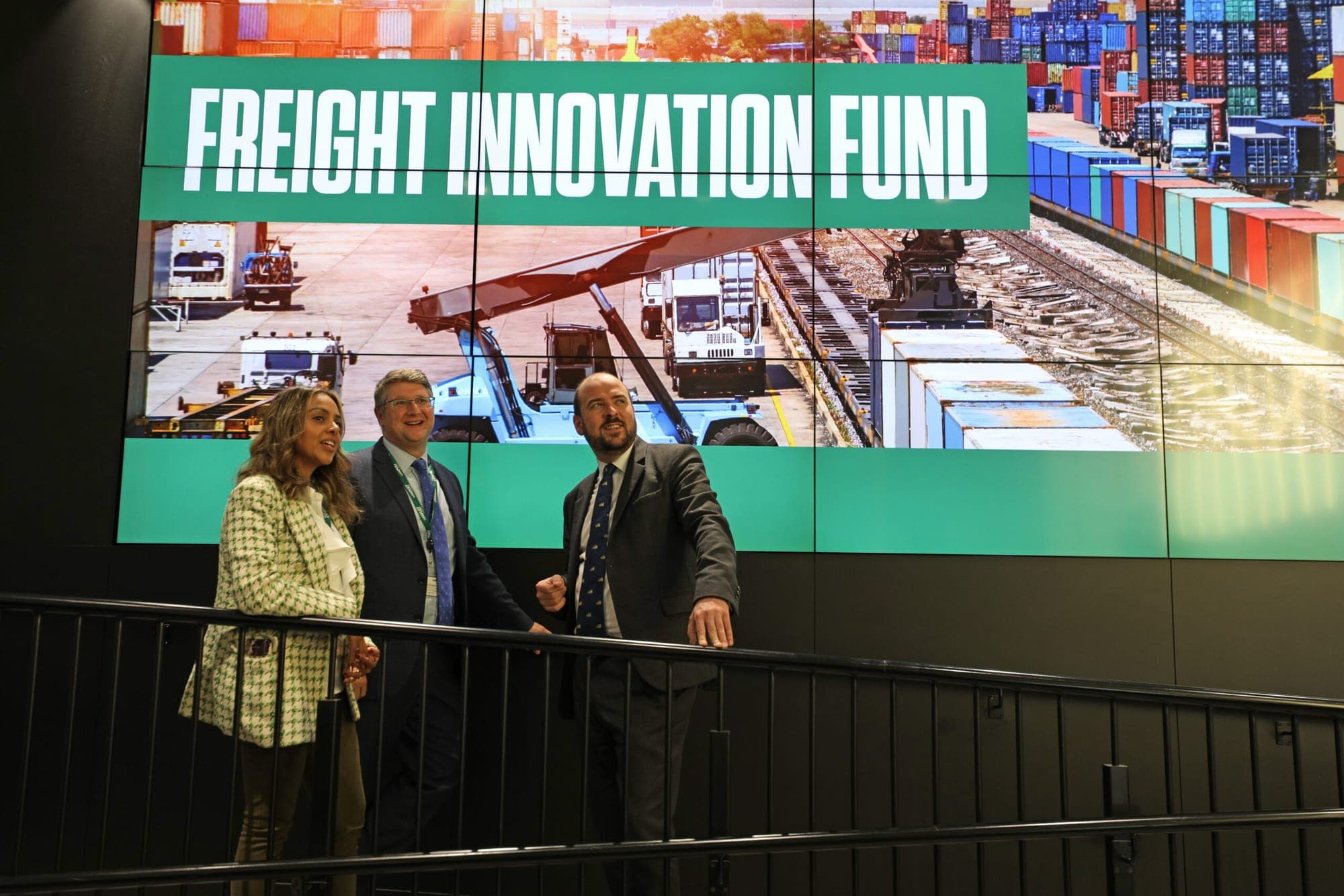
Freight Innovation Fund
DfT · Connected Places Catapult
£100k
per SME trial
Maritime & ports
UK SHORE · DfT + Innovate UK
£121m
CMDC7, open
A point worth being straight about: not every pot writes the operator a cheque. The FIF grant goes to the SME, not the host. What the operator gets is the funded trial, the early access, and the influence. The money that reaches an operator directly tends to come through demonstrator consortia, where you're a funded partner rather than a host. The £200m ZEHID programme shows the shape of that: around 350 zero-emission trucks going onto live operations, its consortia built entirely around operators. ZEHID itself is already in flight and its cohorts are full, so it isn't a door you can walk through today. But it's the template the next demonstrator calls will follow, and it's the clearest proof of why an operator with a track record is worth a consortium's time.
Why us
We're not describing this from the outside. We're already in it.
TwentyForty is a named industry partner on the Freight Innovation Fund Accelerator. We're one of the operators that freight SMEs get matched with to trial their technology in a real environment. We've sat on the partner side of these programmes, run the trials, and seen what separates the bids that land from the ones that don't.
So when we say the operator is the scarce resource, it isn't a pitch. It's the seat we already occupy, and the one we can help you into.
It costs you time. It pays off out of proportion to it.
We won't pretend it's free. A trial takes real hours: from your transport team, your drivers, sometimes your workshop. That's the genuine cost, and it's why most operators pass.
But the operators who spare the time get back what the grants can't buy. Funded assets, early access to technology, and a hand on the rules everyone else will eventually have to follow. The time compounds. The depot you open up for one trial becomes the depot every programme wants next.
The hard part isn't the commitment. It's knowing which programmes are worth it, getting into the right consortium, and structuring it so it fits around an operation that still has to deliver pallets every day. That's the part we do.
01
Work out what you've got
Your routes, your depots, your data. We help you see which of it is valuable to which programme, because not all of it is, and the fit is what gets you in.
02
Get you into the room
An SME operator can't field a bid team. We connect you to the consortia and partners already assembling, so you join as the operator they need rather than cold-pitching.
03
Make it fit the operation
Structure the commitment so it works around live deliveries. We're operator-led, so we know where trials bite a real operation and how to keep them from getting in the way.
How we help
Operator-led, and already on the inside.
TwentyForty exists because the operators with the data these programmes need are the ones least able to chase them. We know what the programmes ask for and what they're actually worth, because we're in them. If you can spare some time, we'll help you point it at the ones that pay off.
Related guides
Each one digs into a specific decision in the freight transition.
Last reviewed and updated 31 May 2026. Sources: Innovate UK, Department for Transport, Connected Places Catapult, Zenzic, Advanced Propulsion Centre.
Flag a correction →